It
this
era
of
sensationalism,
we
should
appreciate
director
Anant
Mahadevan
for
treating
Phule
with
calm
and
composure
and
not
going
overboard,
notes
Hemant
Waje.
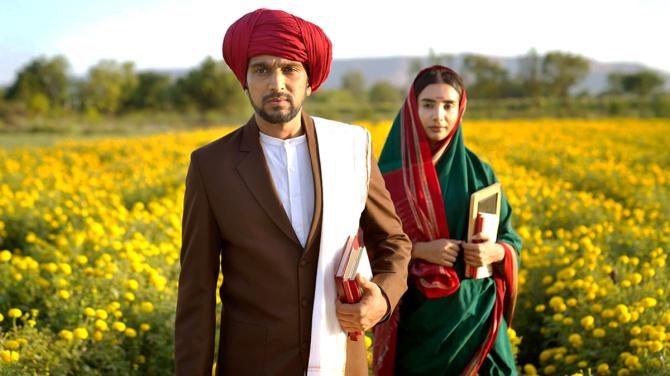
Against
the
backdrop
of
a
deeply
divided
society,
Phule tells
the
powerful
story
of
India’s
first
Mahatma,
Jyotirao,
his
wife
Savitribai
and
their
relentless
work
for
girls
education,
truth,
reason
and
equality.
Most
people
know
the
Phules
for
starting
India’s
first
school
for
girls
but
the
film
shows
many
other
important
things
they
did,
highlighting
their
role
as
strong
reformers
who
stood
up
for
equality
and
fraternity.
The
biopic
opens
in
1897
during
the
bubonic
plague
outbreak
in
Poona
(now
Pune),
where
Savitribai
(played
by
Patralekhaa)
and
adopted
son
Yashwant
(Darsheel
Safary)
are
shown
helping
patients
at
a
medical
camp.
From
there,
the
story
goes
back
to
1848,
where
a
younger
Jyotiba
(played
by
Pratik
Gandhi)
and
Savitribai
are
secretly
teaching
girls
from
all
castes,
with
the
support
of
two
of
Jyotiba’s
Brahmin
friends.
When
the
orthodox
Brahmins
find
out
about
the
school,
they
vandalise
it
and
beat
up
Jyotiba.
Notably,
they
don’t
harm
the
Brahmin
men
who
helped
him,
highlighting
how
caste
privilege
worked,
even
among
reformers.
After
facing
threats
from
a
Brahmin-dominated
panchayat
warning
them
of
dire
consequences,
the
Phule
couple
is
forced
to
leave
their
home.
With
the
help
of
his
college
friend
Usman
Sheikh
and
his
sister
Fatima
Sheikh,
they
continue
their
mission
to
fight
for
girls’
education
and
equal
rights.
The
film’s
flow
is
simple
without
any
overly
or
covertly
messaging.
It
is
very
direct
and
states
what
has
happened
in
that
period.
It
mostly
sticks
to
history
and
never
goes
out
of
radar
of
its
subject.
It
also
shows
the
cruelty
faced
by
people
from
lower
castes.
In
one
scene,
a
man
is
shown
with
a
pot
hanging
from
his
neck
(for
the
Brahmins
to
spit
into
it),
and
a
broom
tied
to
his
waist
(to
sweep
away
the
footprints
of
the
untouchables)
—
symbols
of
the
painful
reality
of
untouchability.
In
another
scene,
it
show
how
Brahmins
are
running
from
Phule’s
shadow.
Phule approaches
each
reform
initiated
by
Jyotiba
with
care
and
without
any
exaggeration.
Take
the
incident
of
young
Brahmin
boys
throwing
cow
dung
at
Savitribai
and
Fatima
Sheikh
(played
by
Akshaya
Gurav),
who
are
going
to
school
to
teach.
The
director
resists
the
temptation
of
not
using
it
repeatedly
to
show
their
struggle
to
get
the
sympathy,
a
refreshing
contrast
to
the
overdramatised
tropes
of
current
biopics.
The
film
also
brings
attention
to
lesser-known
associates
of
the
Phules,
including
Fatima
Sheikh,
Usman
Sheikh,
Lahuji
Raghoji
Salve
and
Dr
Vishram
Ramji
Ghole,
individuals
who
played
key
roles
in
the
reform
movement.
The
film
also
touches
on
the
criticism
Phule
faced
for
working
with
British
officers
or
being
seen
as
close
to
Christian
missionaries.
In
one
scene,
a
British
officer
offers
him
a
chance
to
convert
to
Christianity
but
the
film
handles
it
without
judgment.
While
the
first
half
of
the
film
moves
slowly,
the
second
half
picks
up
pace.
It
shows
Phule’s
stand
against
other
reforms
like
his
criticism
of
widow
tonsure,
opening
a
shelter
for
discarded
women
and
starting
Satyashodhak
Samaj,
an
organisation
that
would
challenge
Brahmins’
religion
and
their
‘prathas‘.
The
film
also
includes
a
scene
depicting
a
Satyashodhak
marriage
—
conducted
without
a
priest
and
free
from
ritualistic
excess
—
followed
by
a
courtroom
battle
defending
its
legitimacy.
Both
the
lead
actors
Pratik
Gandhi
and
Patralekhaa
do
justice
to
their
characters.
Pratik
gives
a
strong
and
composed
performance
as
Jyotiba
Phule.
His
dialogue
deliveries
are
straightforward
and
not
loud.
However,
a
Gujarati
accent
is
noticeable
in
some
of
the
Marathi
dialogues.
Patralekhaa
as
Savitribai
starts
off
with
a
quieter
role
but
grows
stronger
as
the
film
progresses,
especially
after
the
intermission.
Vinay
Pathak
as
Jyotiba’s
father
and
Sushil
Pandey
as
the
Phule’s
older
brother
come
and
go
whenever
they
are
needed.
The
film
has
also
shown
a
property
dispute
with
Jyotiba
and
his
brother.
It
this
era
of
sensationalism,
we
should
appreciate
director
Anant
Mahadevan
for
treating
this
biopic
with
calm
and
composure
and
not
going
overboard.
Phule
Review
Rediff
Rating: