
‘Your family doesn’t want you to come to this field because there’s no direction, no formula.’
‘It’s not as if your career is settled and you will get work consistently.’
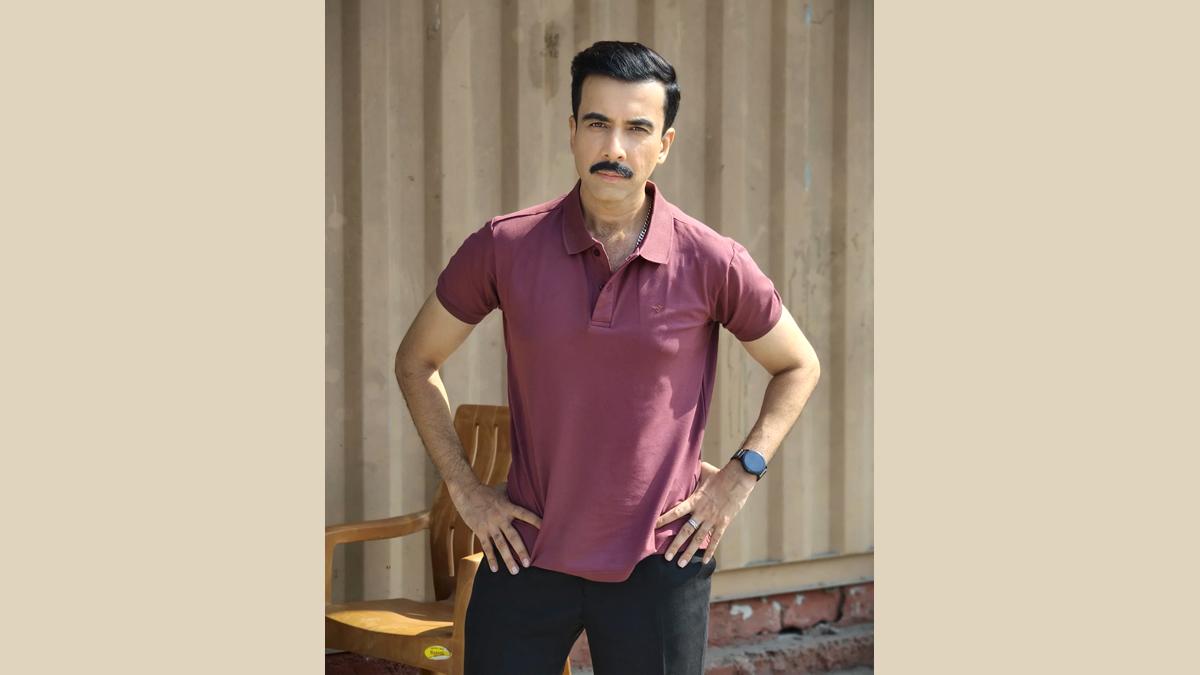
The ultra-competitive nature of the entertainment industry is known, thanks to limited opportunities and a large talent pool.
For Naveen Kasturia, it’s a different approach.
He would rather wait for the right role to come by rather than jump from one project to another.
“Acting is a privileged job,” the actor says.
Before he became an actor, Naveen pursued a corporate job after an engineering degree.
He started his journey in 2014 with Sulemani Keeda and became a fan favourite with shows like Pitchers and Aspirants.
Naveen took a detour from his everyday guy image with a larger-than-life, ‘hero-like’ character in the JioHotstar show Salakaar where he plays an Indian spy in the 1970s trying to neutralise Pakistan’s nuclear ambitions.
“For any actor, being a spy is the coolest character. There’s nobody braver than the person who’s ready to give up his life,” Naveen tells Mayur Sanap/Rediff.
What’s the coolest thing about playing a spy?
I don’t know. But if you talk about the character, there were a lot of cool things about it.
I’ve never done a character like this before.
The way Faruk (Kabir, director) visualised this character, he wanted it to be a little stylised.
He’s put me in a leather jacket.
I’m riding a bullet in the dark.
I was doing action for the first time.
I got to punch somebody.
As an actor, all these things are pretty cool.

What would be your enduring memories from Salakaar?
I have done so many things for the first time with this show.
I will never forget my stay in Ladakh or riding a bike there, wearing cool shades.
I have driven every vehicle in the world for this show, from a scooter, a bike, a tempo, a truck, a vintage car…
I am not going to forget the action.
I am not going to forget the sequence where I was hanging from the harness.
I got the chance to be a father for the first time in the show.
I find those scenes very difficult.
I get awkward and conscious.
The next time I get to be a father, I think I will be better.
How did you become a spy for this show?
For any actor, being a spy is the coolest character.
There’s a lot of inherent heroism, sacrifice and bravery involved.
There’s nobody braver than the person who’s ready to give up his life.
If I had to work on something, it was a little physicality.
I have a very petite frame.
They wanted me to work out a bit.
I had to do some action rehearsals.
You know, if I’m firing a bullet, a gun, it should look believable.

There are some parallels one can draw between your character and Ajit Doval. Was this show inspired by him?
It’s not based on any one person.
It’s an amalgamation of a lot of spy stories.
I was not trying to impersonate anybody.
If you had to use your spy craft on any celebrity, who would it be?
M S Dhoni. The way he conducts himself, his personality, his zero-attention-seeking attitude, I find it very inspiring.
I think he spends a lot of time with himself and his family and friends.
He’s also not on social media.
I would love to know what he does when he’s not in front of the camera.

Pitchers brought you into the limelight in 2015, but you chose to do few projects. Was there a struggle to sustain success after a breakthrough year?
I don’t know how to find a good script.
Working on something, you don’t even know if it’s going to be a breakthrough part, honestly.
You choose things that come to you and you give your 100 per cent.
I don’t think we make a lot of good stories, and the possibility of it coming to you is even less.
It’s a very luck-dependent business.
Your family doesn’t want you to come to this field because there’s no direction, no formula. It’s not as if your career is settled and you will get work consistently.
What made you want to get into the movies?
I came to Mumbai 17 years ago, and have been an actor since 10.
Things are a little different today.
The avenues are more. People are becoming stars via Instagram.
There are many influencers, so many brands.
The competition is very high.
But as compared to that time, work has been more, OTT has become big.
At that time, there weren’t that many avenues, films were the only medium.
What was the lure of the movies for you?
I was just fascinated by this world.
I was a big Govinda fan, a big Aamir Khan fan.
In the 1990s, you were exposed to only Hindi cinema.
When you went to college, you got exposed to international work.
I have been a fan of Irrfan Khan since the late 1990s. You understand nuanced acting.
Then there was a time of Dibakar Banerjee. He made Khosla Ka Ghosla! and Oye Lucky! Lucky Oye!.
Those movies made me feel that different kinds of stories can be made in India.
I came to Mumbai to be a filmmaker. I was not thinking of becoming an actor.
I didn’t know how to be an actor.
I thought I would write good scripts, impress the makers, make my own film and then probably someday, I’ll act too.

What pushed you to take a leap from a regular job to acting?
My idea was to enjoy life.
My father used to tell me study well and only then life will be settled.
But when I starting working, I found it boring.
That’s when these revolutionary thoughts came to me. Like, you know, I’ll go to Bombay and try my hand at filmmaking.
I think it came out of boredom.
Tell us about your college days.
I was in Delhi till 2008; I studied at the Delhi College of Engineering.
I remember I could not crack auditions in my first year of college.
Then I wrote my own play and it did really well in college. I became a known name. That gave me confidence.
I assisted Mahesh Bhatt, and then Dibakar Banerjee. I met Amit Masurkar (director, Sulemani Keeda, Newton, Sherni) there.
Both of us were writers trying to make our own film.
Amit got the idea of Sulemani Keeda and thought of me as an actor for his film. I was auditioning for ads to earn money at that time.
After Sulemani Keeda, Pitchers happened and that changed a lot of things for me.

What’s the joy of being an actor?
I am fascinated by this medium.
Sometimes, as actors or creators, the kind of things we get to experience while filming is unparalleled.
I don’t know how to ride a bike properly. I dropped my bike on the Salakaar on the first day.
But you’re learning, you’re riding, you’re becoming a hero, you’re pulling out a gun, you’re doing action…
I feel grateful to be a part of this world.
Acting is a privileged job.
I’ve been living a retired life since the age of 30.
You work when you feel like working.
You come across a script that you really like and you give your 100 per cent to that role.
Then you wait for the next role.
Waiting is a very important part of our profession.

How do you look at competition?
I stay away from that.
I spend time with my parents, my wife and my sister.
I don’t really have a lot of film friends.
Salakaar is similar to the Netflix show Saare Jahan Se Accha, which stars your best friend Sunny Hinduja. Did you two talk about this at any point?
(Laughs) I was just talking to him before this interview.
He is in Ahmedabad now, and I was sending him screenshots of reviews.
The reviews are loving him. I think he has killed it.
Saare Jahan Se Accha was shot before Salakaar.
When he was shooting, I didn’t have Salakaar with me, and I didn’t know the story of his show.
People are seeing this similarity now.
If people like my show and I get liked, I am happy about it.
Comparisons are a part of this field, they don’t bother me.
