
‘What I want right now in life is more of the same. I just want to do good work and balance it very well with living my life with my family and friends and travel.’

Saif Ali Khan slips into the morally conflicted world of Kartavya with remarkable ease, portraying a man torn between duty, survival and conscience.
In this candid conversation with Subhash K Jha, the actor opens up about trusting Director Pulkit’s vision, revisiting the rustic intensity audiences first saw in Omkara, balancing craft with instinct, and why stories steeped in moral ambiguity excite him the most.
Key Points
- ‘Fortunately, because I did Omkara, I still get offers which are a little different and rustic.’
- ‘Kartavya is a moral tale with a soul in jeopardy and which side does my character end up on.’
- ‘Is he one of the good guys or does he succumb to the bad side? Films with a moral ambiguity are the best kind of stories.’
Kartavya gives you that rare opportunity to assume a character completely alien to you. How deep within yourself did you have to delve to reach the core of Pavan?
I suppose this is where the director comes in because it is a character that is a little alien culturally.
When you have experience in life, really understanding certain roles, then there are many nuances you can bring to it that are very difficult to actually kind of pick up or copy unless you know what you are talking about.
But if the director knows the world, then he can make it much easier. And my director Pulkit really does. So all credit to him in that sense. And then, of course, ultimately the character is what you are bringing yourself to.
And, you know, it’s you playing it. And that is the most unique thing about it. So you play yourself in those circumstances. So that’s kind of how it works. But I’m making it sound like I’m some expert, which only time will tell.
Aren’t you an expert performer?
I don’t think I am really yet. But it’s fun to try and imagine and to get into something that’s a little different from who you are.

What was your reaction to Pulkit’s offer of playing this rustic morally challenged character? Was the accent the hardest part of the character?
Fortunately, because I did Omkara, I still get offers which are a little different and rustic because people feel I could do it if I could do that (Omkara). So that’s a really great thing.
I really liked Pulkit’s script. It’s real and it’s a good hero’s role.
It’s about all kinds of pressures that this character faces at work and with his family and eventually has to keep making these choices about how he’s going to get out of this mess, which is what makes an interesting film really is when you strip it all down.
It’s a moral tale with a soul in jeopardy and which side does my character end up on.
Is he one of the good guys or does he succumb to the bad side? Films with a moral ambiguity are the best kind of stories. You don’t get them all the time. And this is the one time I got it. So I jumped at it.
Would you agree Kartavya is your most challenging character since Omkara?
No, it wasn’t the most challenging. It was kind of challenging, but not really. I think the accent takes a bit of work, but I’ve done it before. And over the years, you know, you build up a kind of practice.
If you keep doing it for long enough, you get better and better hopefully. So being in the moment is always the hardest part for me.
I find the more I’ve applied my mind, the more I’ve given it time to rehearse and practice, the better I am. So it’s nice to be able to give it time. So hopefully people will like it.

Did it take you time to get on the same page as Pulkit?
It did not take time to get onto the same page as Pulkit. It happened from day one. I love good directors like this. Really good directors who wear it all very lightly. I mean it’s just nice for everyone.
He sets the tone on the set. He’s a very cool person. Him and his lovely wife, Jo. They are a great team. And he’s making jokes and he’s fun and he knows exactly what he wants and he knows how it’s done.
He knows the world he’s talking about. So we were not trying to figure it out on the set. Sometimes nobody really knows anything. And that’s a very scary situation because you can keep going endlessly. But we were on the same page immediately.
Pulkit is calm, sociable and brilliant.
He’s one of those guys, he’s the captain of the ship. And you are very happy working with this person and for this person because you are ultimately working for him.
You want him to love what you’re doing and he’s telling you what to do. The director is the first audience we act for. It was wonderful to be on the same page as him immediately.
Besides Kartavya, which of your films and characters do you like?
I don’t know… I mean, there are a few films I have done that I really like Hum Tum and I like Omkara and I like Kalakaandi very much. There are parts of other films, there’s Ek Haseena Thi, I like Tanhaaji.
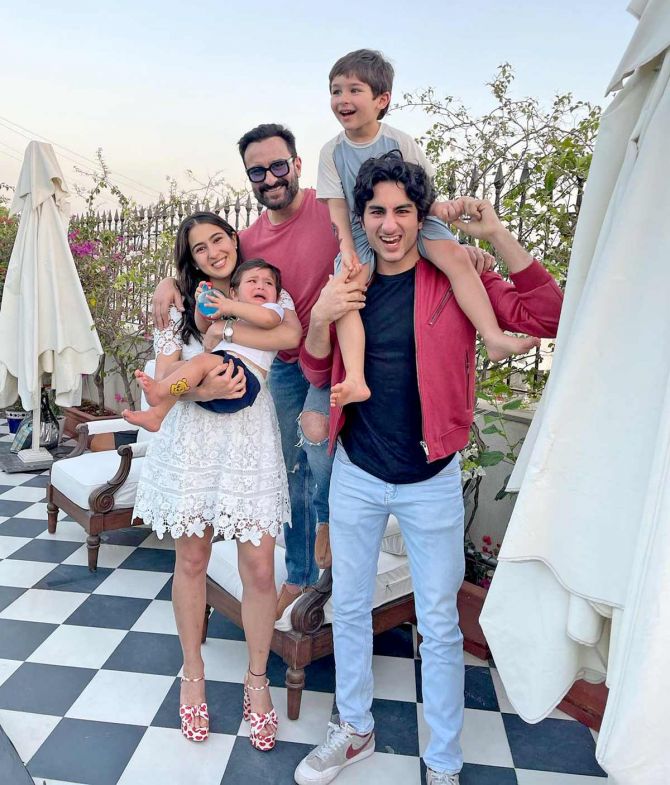
Which of your films do your children really enjoy?
I don’t know if any of my children enjoy any of my films. We don’t really talk about it. Except I think Jehangir has liked Bhoot Police a lot. So that is great.
What is your advice to your eldest son who is going through a turbulent beginning?
My advice to Ibrahim is to work hard, to keep trying to improve and to work on his speech. It’s a very competitive, very tough line of work. You have to keep your head down and keep going.
At this juncture of your life, what do you want most?
What I want right now in life is more of the same. I just want to do good work and balance it very well with living my life with my family and friends and travel.
Life has been very, very good to me. I feel blessed to be in this space and I would like it to continue.
Photographs curated by Satish Bodas/Rediff
