
Mammootty’s greatness lies not in hiding his flaws, but in turning them into his most powerful acting tools, observes Sreehari Nair.

We were on the subject of Mammootty’s longevity when Jitesh R V uttered the unsayable: “He’s a highly insecure man, and that is the key here. His irritability is what keeps him going. Sitting and meditating and making that illuminating discovery…that isn’t him.”
You expect a statement like that from a detractor, or a sour apostate, but Jitesh happens to be a card-carrying Mammootty fan. And yet there he was, not denouncing all those charges that have been customarily levelled against Mammootty, choosing instead to cast those charges in a new light.
While fans of Indian superstars tend to be persistent, militant, confused or litigious, Mammootty fans fall squarely in the category of tough-minded.
When they cite box-office receipts, the effort is always tinged with a hint of goofery. They laugh at the frailties of their superstar and put fresh spins on his supposed shortcomings.
“You want to make fun of his dancing? Let me do it for you.” He is their maimed emperor, majestic but all too mortal.
“Ever seen an actor who fights with his face? That’s our Ikka.”
Such responses should tell you something about the complex feelings that this most unique of Indian superstars inspires.
The progressive non-Malayali media wish to profile him in all his vivid particulars, but they’re not quite sure how to take stock of his dimensions.
They are correct in calling him gutsy, an artist behaving like a man possessed in the twilight of his life, the one who cured himself of that malady that has plagued almost every Indian superstar to date, namely, self-love. But then they turn him into a mascot for their movement and end up cheapening his journey.
To my mind, Mammootty’s resurgence is the story of someone who resized his professional ego, who changed the slogan on his business card from ‘How misunderstood am I!’ to ‘Do not understand me too quickly!’ And now, when I hear him being neutralised by easy assimilations, I fear that we’ll understand him too late or not at all.
To begin at the beginning, he had always been a turbulent personality: Ambitious, brusque, impatient and moody, endowed with the strut of champions, deficient in textbook humility. It also didn’t help that his approach to acting was radically different from that of Mohanlal’s.
If Mohanlal is a social butterfly, it’s because screen acting for him is about getting to a state of total relaxation, the search for a sense of equanimity, letting his body go so loose that it becomes one with the surroundings.
This is the meditative process responsible for, among other gems, the delicious lechery of Maathu Pandaaram, the oblique peeks of Jayakrishnan, and Neelakandan’s part-comic, part-devious twirling of that much-mythologised moustache.
For Mammootty, the gadfly, performing in front of the camera has very often been a matter of proving a point. The more creatively disruptive an environment, the better for his muses.
A tiff, a cutting remark in the press, a show of disrespect on the sets — these are the inspirations for those curled lips, that voice that can animate everything from great kindness to the basest of human emotions, a courage that doesn’t think twice before lousing up that beautiful, beautiful face.
I say this with a certain disregard for poetics and a certain fondness for street wisdom: Mohanlal acts out of the calm inside him, Mammootty acts out of the storm inside him.
The storm has associations that stretch back to his childhood. In an interview with Karan Thapar, Mammootty describes his first memory of the movies thus: ‘A man on a horse gallops toward a damsel and rescues her. All through this, he’s wearing a tie which keeps fluttering in the wind.’
Now there’s a dream merchant speaking, the classic Indian superstar with imperial airs.
He’s convinced that the happiness of mankind depends on how well he advances his own celebrity.
One of his many antecedents is Rajesh Khanna, who would frequently tweak the script of his movies so that his character could die at the end and the audience could walk out longing for more of… Rajesh Khanna.
This is the context to read the starry excesses that mark the first half of Mammootty’s career — his immoderate love of sunglasses, the temerity to question his directors’ demand for retakes, a needless curiosity for what the other actors in a scene are wearing.
Mammootty believed that such perks of superstardom were his for the taking, forgetting perhaps that he was born into a culture that doesn’t judge its heroes lightly.
Kerala has been a land of genteel stars like Prem Nazir and salt-of-the-earth leading men like Madhu and Sathyan.
Even when the pay-scale in the Malayalam movie industry was shockingly low, the camaraderie on a set was known to keep up the enthusiasm of the cast.
It was here that Mammootty came to embody the matinee idol in his ivory tower, a stubborn imperial in a democratic world.
His iciness was seen as the reason for his lack of chemistry with co-stars. The hard glow of purpose he radiated became a symbol of his pomposity.
‘Grouchy’ and ‘cranky’ were pretty standard descriptors for his temperament, usually summed up in that all-purpose Malayalam word, jaada. But then the hatchet job reached a whole new level. ‘Fusspot’, ‘Bad sport’, ‘tantrum thrower’, ‘hypochondriac’, the labels spread far and wide, released as secret memos by filmmakers, assistants and associates, and disseminated by the barons of yellow journalism. In dish terms, it was a clean sweep — they even made fun of his road rage!
To a person as sensitive and open as Mammootty, these labels must have felt like scabs. After all, every narcissist is also an innocent who doesn’t quite see the effect that his preening has on those around him.
So we are at a hinge-point in Mammootty’s career, when he was made to reckon with a few unpleasant truths.
The tacit verdict of industry insiders was fast hardening into public perception, and it read, ‘Loved by the masses, but an irksome presence to have around by all means.’
Most stars approach such situations with the mindset of damage control. Some launch extensive PR campaigns to wipe off the smear.
Others try to be better behaved, or at the very least acquire a patina of modesty.
It’s a cottage industry that every star invariably signs up for: Settlements/pay-offs, press agents, pens-for-hire, the slow deflation of irate voices, the gradual swelling of vanities, the pneumatics of it all.
With Mammootty, however, ‘image management’ would have been something of a lost cause. His incurable affliction was that he was too fidgety and restless and wouldn’t have sat still for it.
Besides, it would have meant forgoing his pride in his skills in the interest of mere adoration.
So what does he do? He swallows the bad publicity and declares to the man behind the greasepaint, ‘Maybe you’re not cut out to win popularity contests, and that’s okay.’
This relaxes him. More importantly, it gives him a new slant to work with.
He was used to comporting himself like one born for the spotlight — taking as his birthright the mask of self-pity, the overly rehearsed movements, the stentorian delivery. But now he starts to play off the audience’s awareness of his stiff neck and his starchy disposition.
When Mammootty made peace with the fact that he was no model of human perfection, it freed him up and set into motion one of Indian cinema’s most astonishing switcheroos.
Think how far removed from the hero-on-horseback figure is Vidyadharan from Bhoothakkannadi. Remember Vidyadharan’s big showdown scene — where he slides past a rifle-wielding drunk, as if with feet of clay?
Almost all of our great stars have made their bones playing anti-heroes; here was one willing to turn anti-star at the peak of his box-office powers.
In Azhakiya Ravanan, we see the sculptural face become the face of Ozymandias, as he transforms into Shankar Das, the millionaire with price tags sprouting from his ears. Visibly uneasy in his finery, the millionaire decides to produce a movie — meddling in its every aspect, offering unsolicited advice, and even inserting himself into a frame while puffing on a pipe… and from Kasargode to Kovalam, they all howled with the delight of recognition!
Yes, Mammootty’s must be the only case where an Indian superstar coasting on his personality has come to mean something truly significant.
Who else could have humanised the power-glutton of Pranchiyettan — a man lolling in sackfuls of rice money yet pining for the one thing he cannot have: The respect of his own community?
Every narcissist is an innocent, sure, but sometimes a narcissist with a sense of humour about himself is just what the culture needs.
In Kadal Kadannu Oru Mathukutty, Mammootty plays a Germany-based Achayan who visits a rehearsal camp of Malayalam actors, goes weak-kneed when he meets Mohanlal but quietly ignores the real Mammootty as he steps out of an elevator, sunglasses in place. ‘I’ve heard he’s too much of a snob,’ says the Mammootty character about Mammootty the star.
This must be the first time that the transition from prince to frog has proved to be a wise career move.
What I am trying to describe here is a 30-year-old project, still ongoing, carried out in dribs and drabs. And Mammootty has staged it so well that the average Mammootty fan has lost the thread. He doesn’t know what to make of a God who turns his unfavourable public persona into a shared joke. How do you keep at a fan fight when ‘your star’ has resolved to stop competing on such points of prestige as collections, awards, and honorific titles?
And yet, a Mammootty fan engages in these fights for old time’s sake, to preserve an august tradition, much like the helicopter flypasts at a Republic Day parade. He still dives into skirmishes, even though a charming ‘I’ve-given-up’ murmur now shines through his exhortations.
As of 2026, it’s the media outside Kerala that’s holding aloft the Mammootty banner. They see him as a potential ‘cover story’ and ascribe to him all kinds of grand gestures. But what they lack is an intimate knowledge of his arc, of how a period of shaming and name-calling and sotto-voce remarks had reshaped the very grammar of his acting.

Three decades ago, when Mammootty, the broad-shouldered, deep-voiced man, decided that it was okay to make a fool of himself on the screen, he began to connect with the audience in ways that went beyond the oh-so-safe routine of ‘giving blood to their fantasies’.
The cover story would have it that he took a big risk in Kaathal. But the real risk there was portraying in human terms a husband who mistreats his wife and keeps her from having her just desserts.
Caught up in watching an Indian superstar play a homosexual, we failed to notice Mammootty’s larger project: Bringing to life the lazy weave of moral faults that knits us all.
Come to think of it, it’s a question of craft, and the grand gestures are just a way of putting the spinach in the brownie.
It’s rather funny to contemplate, and breaks every acting-school commandment there is, but when Mammootty started to bring more of himself to his roles, it liberated his style.
In time, he became a wonderful behavioural actor; and with that slightly mocking, free-and-easy manner of his, a more sophisticated one.
The only redeeming moment in Bheeshma Parvam happens when Mammootty as the overlord enquires at the dining table, ‘So what’s for breakfast?’ and, on learning that cylinders of freshly steamed rice cakes have been laid out for him, casually mutters, ‘Oh, it’s puttu, isn’t it? Then I better have some kanji.’
There’s a studied carelessness about him now, a nonchalant grace that makes him oddly attractive. The Italians have a word for it: Sprezzatura.
These days he’s most feebly represented when the universe contracts to accommodate him, as it did in Peranbu — a movie that paints him as an angel saddled with a palsied child, in which various characters at various junctures remind us how handsome he looks, the single father come down from heaven.
The truth of the matter is that he has evolved beyond seeking our sympathy, and in Nanpakal Nerathu Mayakkam and Bramayugam, the thrill is in observing how he incarnates the spoilsport, the killjoy, the incorrigible questioner of status quo who when cornered smiles away his rancour.
When I think of Mammootty today, I imagine him always living at a little distance from his body, regarding his own actions with doubtful side-glances.
In an age of healing and life-coaching and making oneself over, he’s the genius who skipped therapy and expanded his repertoire.
Make no mistake; his ‘imperial side’ is still alive and kicking; only, he has sublimated it in the service of the question: ‘Is excellence being served?’ Acting is both his life’s purpose and his sanctuary, and unlike his contemporaries, he’s not doing this to satisfy a coterie of ‘Yes Men’ or to maintain the size of his retinue.
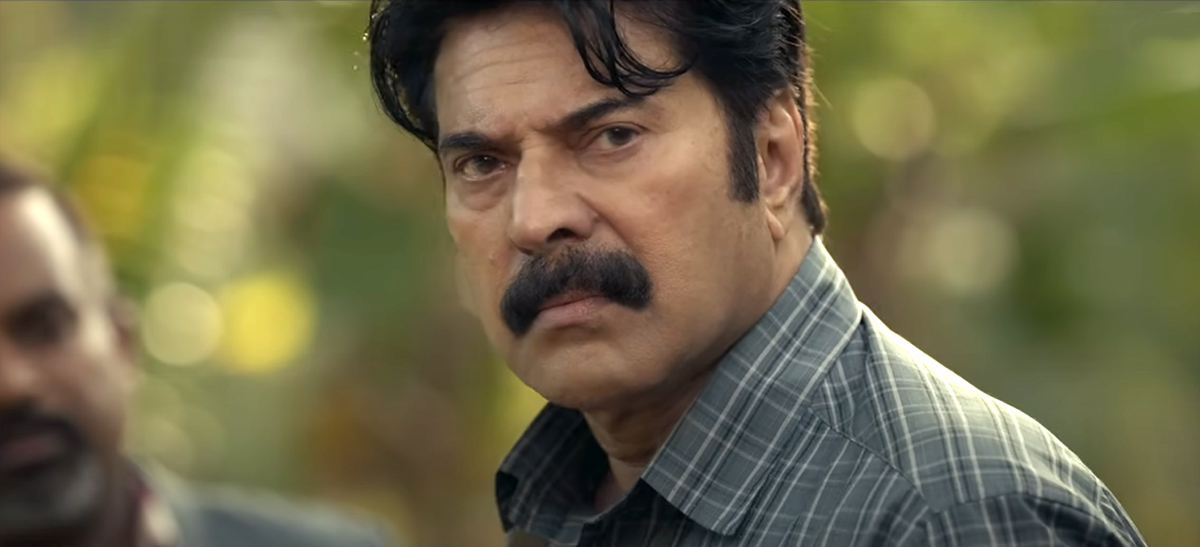
Having suffered from a wave of bad publicity in the first third of his career and having found a way around it, Mammootty seems to have arrived at the realisation that fame is transient, and fandom a phenomenon to be treated with an Olympian wink. And although Ramesh Pisharody follows him everywhere today (Pisharody acts as though he’s Boswell to Mammootty’s Johnson), Mammootty himself seems to believe that in the pursuit of excellence there can be no lasting alliances.
After all, this is someone who brushes away questions about his son’s career with the line, ‘I don’t like to discuss other actors.’
I was recently watching a scene from Unda, and it crystallised for me his present state of mind.
In it, Mammootty’s S.I. character attempts to answer a junior’s query about the spectacle of police duty.
Speaking through thoughtful pauses and measured nibbles, he puts the kibosh on an entire tradition of shootouts and crossfires upon which Malayalam blockbusters had once staked their existence.
It was obvious how his timing as an actor had changed from the days of The King, in which the district collector played by Mammootty had schooled his assistant about the many Indias she wasn’t aware of — the unbelievably sexist exchange, a glorious wash of spit and polish.
But there was more to the scene in Unda. He was now speaking as someone who had experienced the fireworks of celebrity and no longer cared for a piece of that glossed-up machinery.
The man and the artist dwell in the same fortress of solitude. It couldn’t have been any other way. Our bravest superstar is also our greatest loner.
Feature Presentation: Rajesh Alva/Rediff