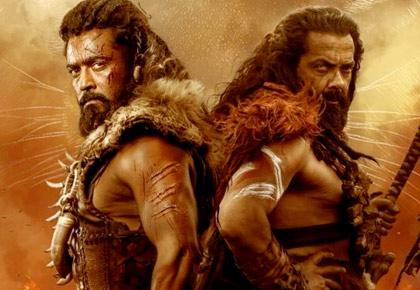
Kanguva
is
a
mishmash
of
conceptually
strong
set
pieces
that
feels
bloated,
as
the
central
scaffolding
holding
together
the
core
themes
of
love
that
heals
over
time
and
eternity,
feels
like
an
afterthought,
observes
Arjun
Menon.

Calling
Kanguva
crass
or
campy
is
beside
the
point,
owing
somewhat
to
the
sweeping
scope
and
ambition
of
Siva’s
extravagant
myth-making.
But
the
film
hits
you
over
the
head
from
the
get-go,
clattering
and
screeching
along,
with
its
borderline
‘assaultive’,
clunky
world-building.
It’s
rare
to
see
a
film
of
this
magnitude,
where
the
majesty
of
the
ideas
on
screen
is
trumped
by
a
jaded
execution.
Siva
is
a
capable
image
maker,
who
has
an
eye
for
layered
compositions
and
staging
choices
that
work
when
pitched
at
a
certain
velocity.
But
the
catch
lies
in
the
B-movie
adjacent
aesthetics
of
his
overall
cinematic
project,
where
blunt
force
is
mistaken
for
sincerity
which
hampers
some
of
his
better
instincts
as
a
film-maker.
Kanguva
is
interesting
whenever
Siva
focuses
the
story
on
the
warrior
prince
Kanguva
(Suriya)
from
a
past
timeline,
whose
life
is
mysteriously
intertwined
with
that
of
a
conniving
bounty
hunter
Francis
(Suriya
again).
Francis’
bumbling
rivalry
and
‘on-off’
romance
with
fellow
bounty
hunter
Angelina
(Disha
Patani)
forms
some
of
the
most
tiring
aspects
of
the
first
half.
Francis’
carefree,
exuberant
existence
is
hampered
after
the
arrival
of
an
odd,
muted
kid,
who
seems
to
have
an
inexplicable
connection
with
both
these
men,
separated
by
centuries.
The
corny-by-design
setting
is
fodder
enough
for
ample
juicy
melodrama,
where
the
time-jumping
shenanigans
can
lead
to
some
swashbuckling
adventure.
While
watching
Kanguva,
I
couldn’t
stop
thinking
of
S
S
Rajamouli’s
sprawling
epic
Magadheera
(2009),
a
film
about
two
lovers
fated
to
romance
separated
by
centuries.
Though
Kanguva
is
doing
a
contrived,
watered-down
version
of
the
‘promise
that
transcends’
time
gimmick,
it
has
none
of
the
chirpiness
or
outsized
imagination
of
the
Rajamouli
outing.
The
film
takes
the
‘promise’
angle
and
runs
with
it,
to
little
effectiveness.
When
a
series
of
events
leads
to
the
kid
being
abducted
in
Francis’
timeline,
you
can
feel
the
non-existent
structure
of
the
screenplay
revealing
itself.
The
first
half
is
spent
setting
up
the
older
timeline
and
building
the
clan
histories,
inter-tribe
wars
and
the
Spanish
expeditions
and
betrayals.
The
film
has
a
stop-gap
effect
at
this
point
and
never
jumps
back
till
the
latter
part
of
the
second
half.
This
is
a
storytelling
choice
borne
out
of
a
narrative
shortcut
strategy,
further
calling
out
the
perfunctory
nature
of
the
present-day
timeline
and
its
sporadic
scope
in
the
bigger
picture.
A
promise
made
by
a
leader
who
alienates
him
from
his
people,
a
little
boy
despising
a
man
despite
his
magnanimous
sacrifice,
a
crew
of
women
upending
the
conventions
of
a
rogue
encounter,
a
warrior
prince
who
is
forced
to
leave
his
own
for
his
moral
rigor,
a
hero
whose
presence
is
filtered
through
the
minds
of
his
clan
through
the
air,
water
and
fire
that
surrounds
them
and
a
fierce,
the
unexplained
intertwining
of
fates
that
connect
two
people
across
centuries…
The
list
goes
on
if
one
starts
to
unpack
the
scope
and
potency
of
the
ideas
here
but
none
of
them
shine
through.
Kanguva
is
a
mishmash
of
conceptually
strong
set
pieces
that
feels
bloated,
as
the
central
scaffolding
holding
together
the
core
themes
of
love
that
heals
over
time
and
eternity,
feels
like
an
afterthought.
Suriya
is
effective
in
playing
up
the
emotional
bluntness
and
his
earnestness
is
the
only
thing
that
somewhat
anchors
Kanguva
from
syncing
into
abysmal
camp
territory.
You
see
the
conviction
oozing
through
his
body,
and
an
actor
committed
to
staying
afloat
a
poorly
conceived
script
that
is
beneath
his
pay
grade
and
cinematic
sensibilities.
Suriya
punches,
howls
and
screams
his
way
through
the
conceptually
potent
yet
underdeveloped
scenarios
with
the
iron-clad
conviction
of
someone
who
has
submitted
to
the
creator
and
his
material,
with
no
qualms
of
holding
back
himself
from
looking
unfettered
on
screen.
To
his
credit,
he
saves
Kanguva
from
an
ambitious
slog
to
some
extent
though
there
is
only
so
much
he
can
do
to
salvage
a
self-imploding
text.
The
much-rumoured
cameo
adds
insult
to
injury
and
comes
off
pretty
awkwardly
at
the
end.
Suriya
eats
up
Kanguva
and
leaves
little
scope
for
any
other
actor
to
count
as
registering
worthwhile
performances,
a
feature
of
the
sketchy,
caricaturish
writing
mostly.
Bobby
Deol
is
wasted
as
the
fierce,
barbarian
king
Udhiran,
who
takes
on
Kanguva.
But
the
shoddy
writing
is
bereft
of
any
sense
of
interiority
for
the
actor
to
settle
down
into
the
skin
of
the
bloodthirsty
maniac,
who
can
pose
any
threat
to
Kanguva.
Disha
Patani
is
asked
to
look
good
on
screen
and
adequately
goes
through
the
motions.
Vetri
Palanasamy
might
be
the
real
winner
here,
as
the
ace
cinematographer
conjures
up
eerie-looking,
atmospheric
visual
spectacle,
and
he
can
find
interesting
ways
to
demarcate
the
different
tonal
high
jinx
of
the
wavering
script
to
some
aesthetic
consistency,
with
his
colour
palettes
comprising
of
reds,
greens
and
blues.
He
gets
to
walk
away
with
an
impressive
showreel
that
can
speak
by
itself
for
his
work.
It’s
ironic
that
Kanguva
is
a
colossal
step
up
for
director
Siva,
in
the
sheer
scope
and
magnitude
of
his
vision
and
yet,
the
messy
and
unwieldy
packaging
calls
out
his
shortcomings
as
a
storyteller.
Misplaced
sincerity
and
an
increasing
dependence
on
primal
emotional
beats
have
become
passé
by
way
of
his
treatment
of
them.
No
amount
of
scope
can
justify
the
visceral
numbness
and
relentless
‘attack
on
the
senses’
quality
of
this
film.
Kanguva
is
at
its
best
when
it
is
a
primal,
resounding
and
unfiltered
scream
and
not
so
good
when
it
tries
to
be
a
sprawling,
franchise
trail
run
that
does
not
come
together
as
a
whole.
Kanguva
Review
Rediff
Rating: